PMP vs CAPM in Hyderabad 2026: Which Certification Should You Choose?
- PMP vs CAPM in Hyderabad comes down to your project leadership experience: CAPM suits beginners with 0–2 years of experience who want to enter project management, while PMP suits professionals with 3+ years of project leadership experience who want senior roles and higher pay.
- Hyderabad’s IT, GCC, and infrastructure employers increasingly ask for one or the other by name in job postings — so picking the right one first saves you months of wasted preparation.
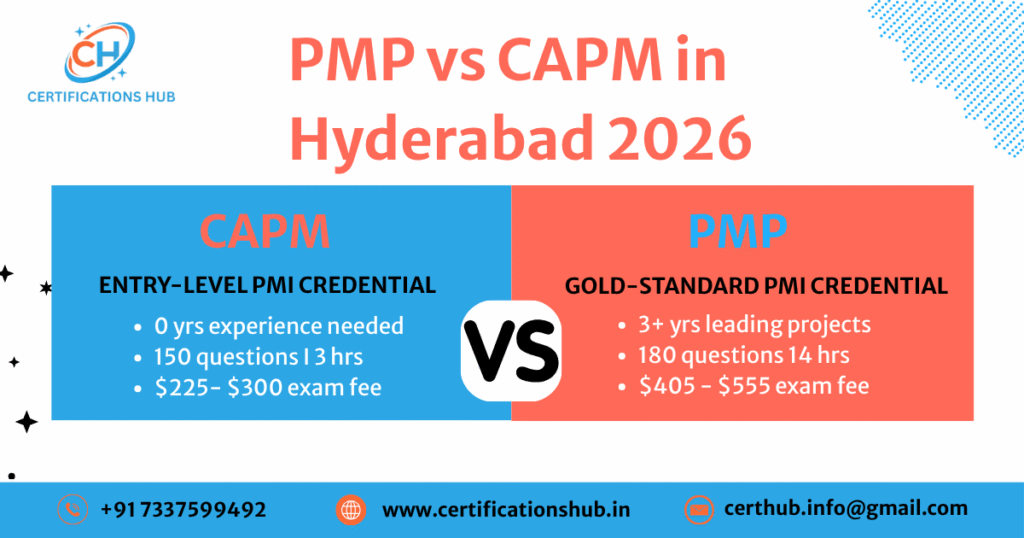
PMP vs CAPM at a Glance
Factor | CAPM | PMP |
Best for | Beginners, students, career-changers | Professionals with 3+ yrs leading projects |
Experience required | None | 36 months (degree) / 60 months (diploma) |
Education requirement | 23 contact hours | 35 contact hours |
Exam format | 150 questions / 3 hours | 180 questions / 4 hours |
Exam fee (PMI member) | $225 | $405 |
Exam fee (non-member) | $300 | $555 |
Domains tested | Predictive, Agile, Business Analysis, PM Fundamentals | People 33%, Process 41%, Business Environment 26% |
Recognition | Entry-level PMI credential | Global gold-standard credential (200+ countries) |
Typical next step | Build experience, move to PMP | Senior PM, Program Manager, PMO roles |
Is CAPM Easier Than PMP?
- Yes — CAPM is designed as PMI’s entry-level credential and tests foundational knowledge rather than applied judgment under pressure.
- CAPM has no work-experience requirement (PMI removed the alternative 1,500-hour experience path in 2024), needs only 23 contact hours of education, and its 150-question exam draws on more straightforward recall and framework questions.
- PMP’s 180-question exam leans heavily on scenario-based judgment questions that test how you’d actually lead a team through a real project situation — which is why PMI requires 36–60 months of documented project leadership experience just to sit for it.
Should I Do CAPM Before PMP?
- If you have fewer than 3 years of experience leading or directing projects, yes — CAPM is the practical starting point. It builds your PMI-aligned foundation, and PMI itself waives the PMP’s 35-contact-hour education requirement if you already hold an active CAPM, since you’ve already completed equivalent coursework. If you already have 3+ years of real project leadership experience (even without a “Project Manager” title — team leads, operations managers, and IT leads all qualify), you can skip CAPM entirely and go straight for PMP, since it carries stronger recognition and salary impact.
ELIGIBILITY
PMP vs CAPM Eligibility Difference
CAPM Eligibility:
- Secondary diploma (high school or global equivalent) — no degree required
- 23 contact hours of formal project management education
- No prior work experience needed at all
PMP Eligibility:
- Degree-based path: 4-year degree + 36 months leading and directing projects + 35 contact hours of education
- Diploma-based path: High school diploma/associate degree + 60 months leading and directing projects + 35 contact hours of education
- Experience must involve leading and directing projects, not just participating — team leads, Scrum Masters, and operations managers all qualify
CAPM vs PMP Salary Difference in India
CAPM and PMP produce very different salary outcomes because they target different career stages, not because one certification is “worth more” than the other in isolation.
Role Level | Certification Typical at This Stage | Salary Range (Hyderabad)* |
Project Coordinator / Analyst | CAPM | ₹5–9 LPA* |
Associate Project Manager | CAPM → transitioning to PMP | ₹8–12 LPA* |
Project Manager | PMP | ₹10–18 LPA* |
Senior Project Manager | PMP | ₹18–28 LPA* |
Program Manager / PMO Director | PMP | ₹28 LPA+* |
- Within about 24 months of earning CAPM, most professionals accumulate enough documented project leadership experience to become PMP-eligible — at which point PMP becomes the natural next step, and the salary jump tends to follow the credential.
Who Should Choose CAPM Over PMP?
- Students and recent graduates entering Hyderabad’s IT/GCC job market who want a PMI credential before gaining work experience
- Career-changers moving into project support or coordination roles from another field
- Team members and analysts who support projects but don’t yet lead them, and want to formalize their understanding of PM fundamentals
- Anyone who doesn’t yet meet PMP’s 36–60 month experience requirement but wants a head start on the PMI ecosystem
Who Should Choose PMP Over CAPM?
- Project Managers with 3+ years of experience leading and directing projects, regardless of job title
- IT and GCC professionals at Amazon, Microsoft, Google, and Salesforce delivery centers in Hyderabad are transitioning into formal PM leadership roles.
- Construction and infrastructure leads on projects like Hyderabad’s Metro Rail expansion
- Anyone targeting Senior PM, Program Manager, or PMO leadership roles, where PMP is frequently listed as a preferred or required qualification
2026 UPDATE
Does the New PMBOK 8 Update Affect PMP vs CAPM?
- Yes, but only on the PMP side for now. PMI’s updated PMP exam went live on July 9, 2026, aligned to PMBOK 8 — with the Business Environment domain weight tripling from 8% to 26%, and new testable content on AI in project management and sustainability.
- CAPM’s exam content (Predictive, Agile, Business Analysis, and PM Fundamentals) has not seen the same scale of change, which means CAPM remains the more stable, foundational choice if you’re not ready to tackle PMP’s heavier 2026 exam yet.
PMP vs CAPM in Hyderabad 2026 — FAQs
01. What is the main difference between PMP and CAPM?
PMP proves project leadership experience; CAPM is PMI’s entry-level, no-experience credential.
02. Is CAPM a good starting point before PMP in Hyderabad?
Yes — with under 3 years of experience, CAPM builds your PMI foundation and later waives PMP’s 35-hour education requirement.
03. Can I skip CAPM and go directly for PMP?
Yes, if you have 3+ years of documented project leadership experience. They’re independent, not sequential.
04. Which certification pays more in Hyderabad — PMP or CAPM?
PMP pays more since it maps to Project Manager and Senior PM roles, while CAPM maps to Coordinator/Analyst roles.
05. How much does CAPM cost compared to PMP?
CAPM: $225 (member) / $300 (non-member). PMP: $405 (member) / $555 (non-member).
06. Is the CAPM exam easier than the PMP exam?
Yes — 150 questions on foundational knowledge vs. PMP’s 180 scenario-based judgment questions.
07. Do I need work experience for CAPM?
No. Just a secondary diploma and 23 contact hours of education.
08. How long does it take to prepare for CAPM vs PMP?
CAPM: 6–8 weeks. PMP: 8–12 weeks, given its broader scope.
09. Does CAPM certification expire?
Yes, it requires periodic renewal — check PMI’s current cycle and PDU requirements.
10. Which certification is better for IT professionals in Hyderabad's GCC sector?
CAPM for juniors entering project support roles; PMP for those with 3+ years leading technical delivery.
11. Can CAPM help me get promoted faster?
It supports promotion into coordinator/junior PM roles, but the bigger jump comes once you’re PMP-eligible.
12. Does PMI's 2026 PMBOK 8 update apply to CAPM too?
Not much — the major July 2026 changes apply mainly to the PMP exam; CAPM’s domains stay comparatively stable.
13. Should I do both CAPM and PMP eventually?
Usually not — CAPM is a stepping stone until you’re PMP-eligible, then PMP takes over.
14. Where can I get PMP or CAPM training in Hyderabad?
CertificationsHub offers both, with weekday/weekend batches — see our PMP Certification Training in Hyderabad page.
15. What happens if I choose the wrong certification for my experience level?
PMP applications can be rejected/audited without enough experience; choosing CAPM when you already qualify for PMP wastes time. A free eligibility check avoids both.
Still not sure whether PMP or CAPM is right for you?
Talk to our admissions team for a free, personalized eligibility check based on your experience.